
Bird’s Nest Anthurium / Hooker’s Anthurium
Anthurium hookeri
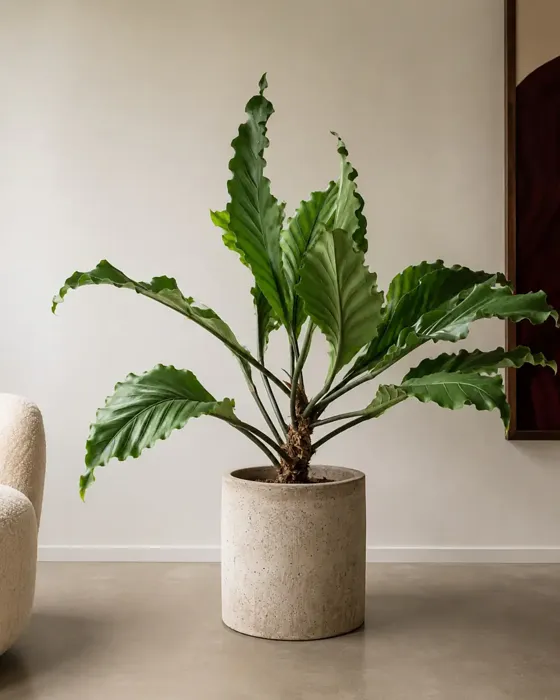
description

Bird’s Nest Anthurium (Anthurium hookeri) forms a broad, upright rosette of long, leathery green leaves with gently rippled edges. Rather than climbing like many anthuriums, it grows as a compact, nest-like crown that can become impressively large. In nature, Hooker’s Anthurium often lives as an epiphyte in rainforest trees, where its leaf rosette helps catch fallen organic debris and moisture.
benefits
- Suitable for containers
warnings
- Toxic to cats
- Toxic to dogs
How to care for Bird’s Nest Anthurium
sunlight
In rainforest understory, Bird’s Nest Anthurium receives filtered light rather than hot, open sun. Give it a bright spot with softened light to keep its broad, rippled leaves growing evenly.
Bright indirect light


Ideal near an east-facing window, or a few feet back from a bright south or west window behind a sheer curtain. Avoid direct afternoon sun, which can scorch or fade the leaves.
Medium indirect light - tolerated
It can manage a moderately lit room, but growth will be slower and leaves may become less robust. Move it closer to a window if new leaves are small or widely spaced.
watering
Keep the mix lightly and evenly moist, but never soggy. Water thoroughly when the top 1-2 inches feel dry, then let excess drain away.
Spring and summer


In bright, warm conditions, this is often about every 7-10 days. Check deeper than the surface in a large pot: the root ball should be slightly moist, not wet, before watering again.
Autumn and winter
In lower light or cooler rooms, water roughly every 10-14 days, waiting until the top 2 inches have dried. A lighter pot is a useful sign that it is ready.
Dry air, strong light, a small terracotta pot, and active growth make watering more frequent. Low light, cool temperatures, a large pot, or a dense mix slow drying.

humidity
Relative humidity
Native to humid tropical forests, Bird’s Nest Anthurium looks best with moderately humid air. It usually adapts to average homes above 40%, but 50-70% supports smoother new leaves and cleaner leaf edges.
Brown, crisp tips or margins, slow unfurling leaves, and frequent curling can signal air that is too dry, especially near heating or air conditioning.
- Use a humidifier nearby if humidity stays below 40%.
- Give the plant space for airflow rather than enclosing it in a constantly wet spot.
temperature
Preferred temperature
Winter minimum
Native to warm, humid tropical forests, Bird's Nest Anthurium grows best in steady indoor warmth. Keep it away from chilly windows in winter and give it airflow if temperatures stay above 30°C (86°F).
nutrition
March - August
Feed about once a month while it is actively growing, using a balanced liquid houseplant fertilizer diluted to half strength. Apply to already-moist potting mix. Skip feeding in autumn and winter unless the plant is clearly producing new leaves in warm, bright conditions.
Nitrogen
Nitrogen supports the large, leafy rosette. A balanced fertilizer used lightly provides enough without pushing soft, weak growth.
Magnesium
Magnesium helps leaves stay green and supports steady growth. It is usually supplied by a complete houseplant fertilizer, so extra supplements are rarely needed.
soil
Chunky, airy soil that stays lightly moist
Its epiphytic roots need oxygen as much as moisture, so use a loose mix of potting soil or coco coir with orchid bark and perlite. It should hold some water without becoming dense or soggy.
pH 5,5 - 6,5
This is mildly acidic, which suits anthuriums well. Most peat- or coco-based houseplant mixes fall close to this range; avoid adding lime unless you know your water and mix are very acidic.