
Christmas Cactus / Holiday Cactus
Schlumbergera × buckleyi
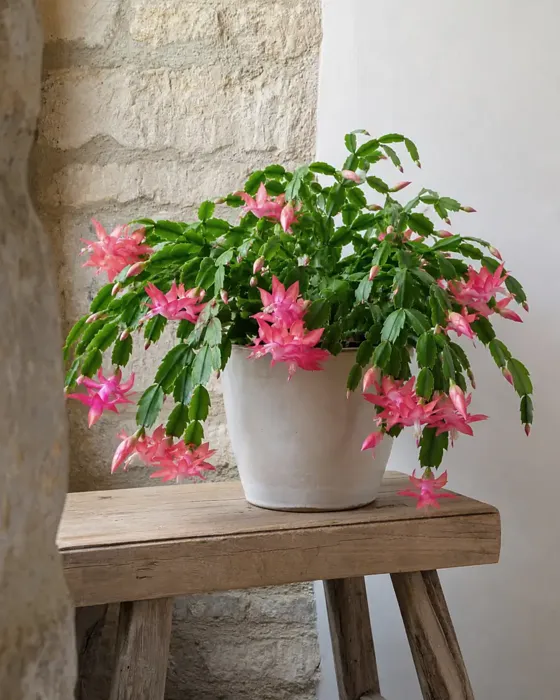
description

Christmas Cactus, Schlumbergera × buckleyi, has trailing chains of flat, glossy green stem segments with softly scalloped edges. Its dangling, tubular flowers open in winter, often in pink, red, white, or purple, bringing color when many houseplants are resting. Despite its name, it is not a desert cactus: this hybrid descends from Brazilian forest epiphytes that grow on trees and rocks.
benefits
- Pet-friendly, non-toxic to animals
- Flowering
- Suitable for containers
How to care for Christmas Cactus
sunlight
In Brazilian forest canopies, Christmas cactus grows on branches in bright, filtered light rather than baking in open sun. Give it a bright spot indoors with softened light.
Bright indirect light


Place near an east window, or a few feet back from a bright south or west window behind a sheer curtain. Gentle early sun is usually fine, but hot midday or afternoon sun can redden or scorch the stems.
watering
Water thoroughly, then wait until the top 1-2 inches of mix feel dry. Christmas cactus likes light, even moisture, but its roots rot in soil that stays wet.
March - August


In bright, warm conditions, water about every 7-10 days. Check the soil first and water when the upper layer is dry and the pot feels lighter.
September - February
Water roughly every 10-21 days as growth slows, using the same soil check. During bud and bloom, avoid letting the root ball dry out completely, as sudden dryness can cause buds to drop.

humidity
Preferred humidity
In its native Brazilian forest canopy, Christmas Cactus grows in moist air around tree branches. Average household humidity of 40-50% is usually fine, but it appreciates a little more moisture, especially while forming buds and in heated winter rooms.
Keep it away from radiators and heating vents. If humidity stays below about 40%, run a small humidifier nearby or group it with other plants. Good airflow still matters, so do not crowd the stems tightly together.
temperature
Preferred range
Winter minimum
Its parent species grow as epiphytes in humid Brazilian forests, so it prefers steady indoor warmth rather than extremes. Keep it above 10°C (50°F), and move it away from intense heat above 27°C (80°F), which can stress the stems and shorten flowering.
nutrition
March - August
Feed about once a month while new stem segments are growing, using a balanced liquid houseplant fertilizer at half the label strength. Apply it to already-moist compost. Stop feeding from late summer through winter, then resume when active growth returns.
Nitrogen
Nitrogen supports healthy green stem growth. A diluted, balanced fertilizer supplies enough without pushing soft, weak growth.
Potassium
Potassium supports overall plant health and flowering. Normal balanced feeding is sufficient, so avoid high-strength bloom boosters.
soil
Airy, moisture-retentive soil
Its epiphytic roots need air around them but should not dry out like a desert cactus. Use a loose mix of potting soil or coco coir with fine bark and perlite, in a pot with drainage holes.
pH 5,5 - 6,5
This is slightly acidic, similar to the organic debris Christmas cacti root into in nature. Most peat- or coco-based houseplant mixes fall close to this range, so no special adjustment is usually needed.