
Florist’s Kalanchoe / Flaming Katy
Kalanchoe blossfeldiana
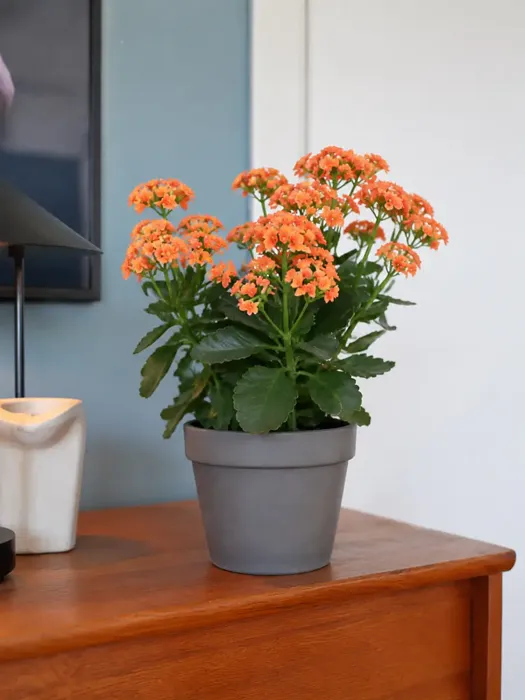
description

Florist’s Kalanchoe (Kalanchoe blossfeldiana), also called Flaming Katy, is a compact succulent with glossy, scalloped dark-green leaves and tight clusters of small four-petaled flowers. Its blooms can be red, pink, orange, yellow, or white, often creating a bright cap above the foliage. Native to Madagascar, it is a short-day plant: longer nights trigger flower-bud formation, which is why growers can coax it into bloom at different times of year.
benefits
- Flowering
- Suitable for containers
warnings
- Toxic to cats
- Toxic to dogs
How to care for Florist’s Kalanchoe
sunlight
Native to Madagascar's bright, rocky landscapes, Florist's Kalanchoe needs much more light than most flowering houseplants. Give it a bright windowsill to keep growth compact and encourage repeat flowering.
Bright indirect light


Place near an east, west, or bright south-facing window with sheer coverage if the sun is intense. Low light leads to stretched stems, fewer flowers, and slow drying soil.
Gentle direct sun
A few hours of morning or late-day sun is welcome, especially in winter. Protect it from harsh midday summer sun through glass, which can scorch leaves and fade flowers.
watering
Let the potting mix dry out most of the way before watering again. Then water thoroughly until it drains from the pot, and empty the saucer.
Spring and summer


In bright, warm conditions, water about every 1-2 weeks. Check that the upper half of the mix is dry and the pot feels light before watering. Small pots, strong sun, and a gritty mix dry faster.
Autumn and winter
In lower light or cooler rooms, water roughly every 2-3 weeks, once the mix is nearly dry throughout. A flowering plant in a warm, bright spot may need water sooner, so test the soil rather than following the calendar.

humidity
Native to Madagascar, florist's kalanchoe is adapted to relatively dry air and does not need tropical humidity. Good airflow matters more than raising humidity.
Typical home humidity
It usually tolerates about 30-60% relative humidity. Below 30%, leaves may develop dry, crisp edges and flower buds can shrivel or drop, especially near heaters.
If your air is very dry, move the pot a little farther from the heat source or use a humidifier nearby. Avoid consistently damp air and crowded placement, which can encourage fungal problems.
temperature
Preferred temperature
Winter minimum
Native to warm Madagascar, Florist's Kalanchoe is happiest in steady room temperatures. It tolerates warmer conditions if it has good light and is not kept soggy, but cold slows growth and can damage leaves and flowers.
nutrition
March - August
Feed about every 4-6 weeks while it is making new leaves and stems, using a balanced liquid houseplant or flowering-plant fertilizer at half the label strength. Stop feeding in autumn and winter unless it is clearly growing actively.
Nitrogen
Nitrogen supports the compact leafy growth that fuels future flowering. A diluted balanced fertilizer supplies enough without encouraging soft, stretched stems.
Potassium
Potassium supports sturdy growth and flower production. A fertilizer made for flowering houseplants can be useful while buds are forming, but use it lightly.
soil
Gritty, fast-draining soil
Its succulent roots need air around them and dry out quickly after watering. Use cactus or succulent potting mix, or lighten regular mix with perlite, pumice, or coarse grit.
pH 6,0 - 6,5
This is slightly acidic, a good range for nutrient uptake. Most fresh cactus mixes are suitable, and a pot with drainage holes matters more than trying to fine-tune pH at home.