
Madagascar Palm / Clubfoot
Pachypodium lamerei
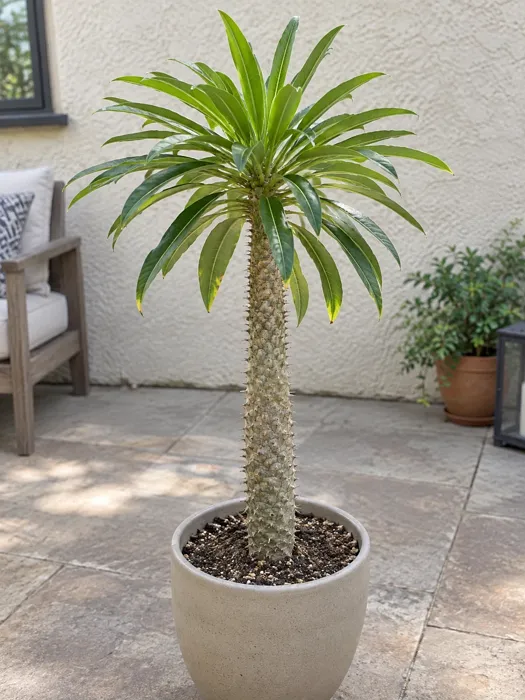
description

How to care for Madagascar Palm
sunlight
Madagascar palms grow in bright, open, dry habitats, so give yours the brightest spot you have. A sunny south or west-facing window helps it stay compact and sturdy.
Direct sun

Place it close to a sunny window for several hours of direct light. Introduce stronger sun gradually over about a week to reduce leaf scorch, especially after moving it from lower light.
Bright indirect light

This is tolerated, especially near a bright east-facing window, but growth may be slower. If the stem becomes thin or the plant leans toward the glass, move it closer to stronger light.
watering
Let the potting mix dry almost completely before watering your Madagascar Palm. Then water thoroughly until it drains from the bottom, and empty the saucer.
Active growth


As a starting point, water about every 2-4 weeks in bright, warm conditions. Check first by lifting the pot or inserting a wooden stick through the root ball. Water when the pot feels light and the mix is dry nearly all the way down.
Cool or low-light season
Water roughly every 4-8 weeks, and less often if growth slows. Lower light, cool temperatures, high humidity, a large plastic pot, or moisture-retentive soil can extend this interval, while strong light, warmth, a small pot, or a gritty mix can shorten it.

humidity
Preferred household humidity
Madagascar Palm comes from the dry, warm regions of Madagascar and usually handles ordinary indoor air well. Aim for about 30-50% relative humidity; it can tolerate roughly 25-60% when the soil drains freely and air circulates.
If humidity stays below about 30%, leaves may develop crisp brown edges or drop early, although seasonal leaf drop is also normal. Do not treat soft leaves or a soft trunk as low humidity, since those signs more often point to excess moisture.
- Run a room humidifier nearby if the air is persistently below 30%, and keep the plant away from cool drafts.
- Grouping plants can provide a small boost, but leave space for airflow and skip misting, which adds little lasting humidity.
temperature
Active growth
Winter minimum
Native to warm, dry Madagascar, Madagascar Palm needs steady warmth and dislikes cold, damp conditions. Keep it in a bright room away from drafts, and move it indoors before temperatures approach its winter minimum.
nutrition
March - September
Feed approximately every 4 - 6 weeks during active growth with a balanced liquid fertilizer made for succulents, diluted to half the label strength. Skip feeding in autumn and winter, or whenever growth has paused. Plants in bright warmth may grow for longer, while cooler or darker conditions call for less feeding.
Nitrogen
Nitrogen supports the Madagascar Palm's leaves and new growth. A cautious, balanced fertilizer supplies enough without encouraging soft, stretched growth.
Potassium
Potassium supports sturdy growth and general resilience. It is normally supplied by a balanced succulent fertilizer, so a separate supplement is rarely needed.
soil
Gritty, fast-draining soil
Madagascar Palm roots need air and should not stay wet. Use a cactus mix amended with pumice, perlite, or coarse sand, and avoid dense garden soil.
pH 6,0 - 7,5
This range is slightly acidic to mildly alkaline. A standard cactus mix is usually suitable; if it holds water or becomes compacted, add more mineral grit rather than extra organic matter.