
String of Pearls / Senecio rowleyanus
Curio rowleyanus
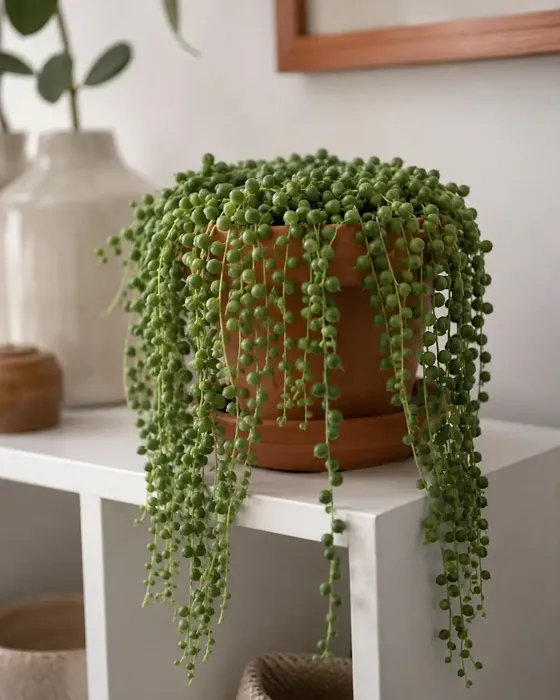
description

String of Pearls (Curio rowleyanus) trails in long, slender strands dotted with round, pea-like leaves. Those bead-shaped leaves store water, an adaptation to its dry native habitats in southwestern Africa. As the stems lengthen, they spill neatly from hanging pots or shelves, and small white flowers can appear with a faint cinnamon scent.
benefits
- Suitable for containers
warnings
- Toxic to cats
- Toxic to dogs
How to care for String of Pearls
sunlight
In its dry South African habitat, String of Pearls often grows with some shelter from rocks and other plants. Give it bright, filtered light indoors to keep the strands compact and the pearls plump.
Bright indirect light


Place it near an east window, or a few feet back from a south or west window. A little gentle morning sun is usually welcome, but hot midday or afternoon sun can scorch and shrivel the beads.
watering
Let the potting mix dry out completely before watering again. String of Pearls stores water in its beads, so it is much safer slightly dry than kept damp.
Spring and summer


In active growth, water thoroughly about every 2-3 weeks. Check that the mix is dry throughout and the pot feels very light before watering, then let excess drain away.
Autumn and winter
In cooler, lower-light conditions, water roughly every 3-5 weeks. Wait for fully dry soil, especially if growth has slowed.
These are starting points, not a calendar. Bright warmth, a small terracotta pot, and a gritty mix dry faster; low light, humidity, a large pot, and a moisture-retentive mix slow drying.

humidity
Preferred humidity
String of Pearls comes from dry southern African habitats, so average household humidity suits it well. It is happiest with dry air and good airflow rather than tropical conditions.
It can tolerate humidity below 30%, but persistently hot, dry air may make pearls shrivel faster. Keep it away from heating vents, and avoid prolonged humidity above about 60%, especially if airflow is poor.
How to help in very dry air
- Use a small humidifier nearby only if the air stays very dry and the plant is drying unusually fast.
- Do not mist regularly, as water sitting on the stems and pearls can encourage rot.
temperature
Preferred temperature
Winter minimum
Native to warm, dry parts of southern Africa, String of Pearls is happiest in steady indoor warmth. Keep it above 10°C (50°F), and give it bright light without pressing the pot against hot glass.
nutrition
March - August
Feed about once a month while it is actively growing, using a balanced liquid cactus or succulent fertilizer diluted to half strength. Apply to moist soil, not dry roots. Stop feeding in autumn and winter unless the plant is clearly producing new growth in warm, bright conditions.
Nitrogen
Nitrogen supports fresh stems and plump green pearls. A gentle, balanced fertilizer provides enough without encouraging soft, stretched growth.
Potassium
Potassium supports sturdy growth and overall resilience. It is supplied by most balanced succulent fertilizers.
soil
Gritty, fast-draining soil
String of Pearls has fine roots that rot easily in dense, wet compost. Use a cactus or succulent mix loosened with perlite, pumice, or coarse grit so water drains quickly and air reaches the roots.
pH 6,0 - 7,0
This is slightly acidic to neutral, a range most cactus and succulent mixes naturally suit. Choose a peat- or coir-based mix with mineral grit, rather than trying to adjust pH at home.